
How Is PCOS Diagnosed? Tests, Criteria, and What to Expect
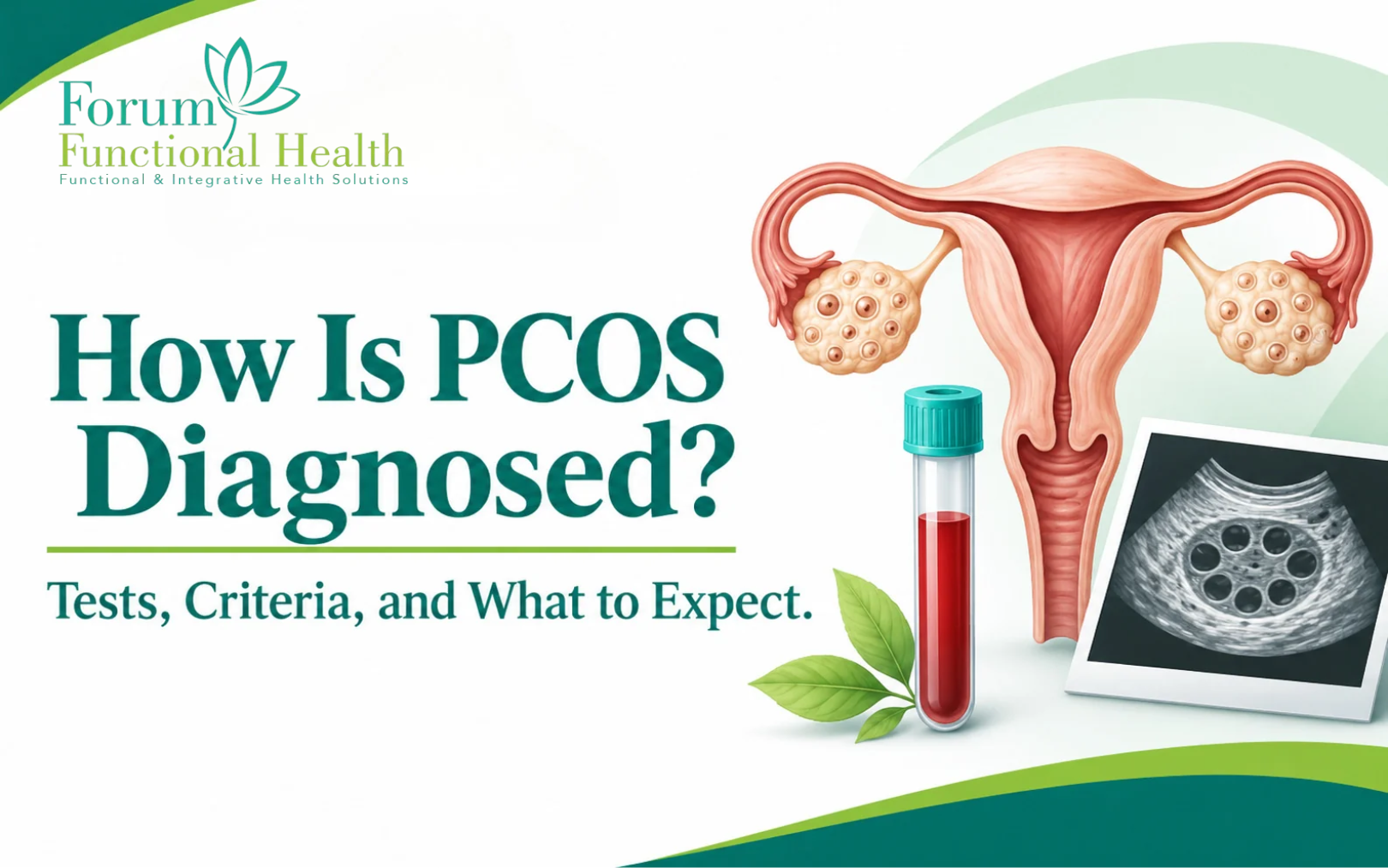
Irregular periods, persistent acne, unwanted facial hair, and difficulty predicting ovulation can raise questions about polycystic ovary syndrome (PCOS). But how is PCOS diagnosed, and which tests do healthcare professionals actually use?
PCOS is diagnosed through a combination of menstrual history, physical symptoms, hormone testing, and sometimes pelvic imaging. In adults, healthcare professionals generally look for at least two of three diagnostic features after excluding other conditions that can cause similar symptoms.
Not everyone needs an ultrasound, and no single blood test can independently confirm PCOS. Understanding the diagnostic process can help you prepare for an appointment and make informed decisions about your hormonal and metabolic health.
How Is PCOS Diagnosed?
Doctors generally diagnose PCOS by evaluating androgen levels, ovulation patterns, and ovarian appearance against established clinical criteria.
For adults, the Rotterdam criteria provide the foundation for diagnosis. At least two of the following three features must be present after alternative causes have been considered:
- Clinical or biochemical hyperandrogenism: Signs of excess androgens, such as unwanted facial hair, or elevated androgen levels on blood testing.
- Ovulatory dysfunction: Irregular menstrual cycles, infrequent periods, or absent ovulation.
- Polycystic ovarian morphology: A characteristic follicle pattern identified through ultrasound or, when appropriately used in adults, an AMH assessment.
A healthcare professional reviews the patient’s symptoms, medical history, and relevant test results to determine whether they meet the diagnostic criteria.
Importantly, PCOS does not simply mean having ovarian cysts. Because PCOS affects both hormonal and reproductive health, doctors evaluate these features together rather than relying on a single symptom or test.
If you are experiencing possible PCOS symptoms, discussing your concerns with a qualified healthcare professional is a sensible first step. You can also explore PCOS treatment to learn about available supportive care options.
What Are the PCOS Diagnosis Criteria?
The Rotterdam criteria are widely used to evaluate PCOS in adults. They help healthcare professionals distinguish between different presentations of the condition.
Not every person with PCOS experiences the same symptoms. Some have irregular periods and elevated androgen levels, while others have different combinations of diagnostic features.
Understanding the Three Diagnostic Features
| Diagnostic Feature | What Doctors Look For | How It Is Evaluated |
|---|---|---|
| Clinical hyperandrogenism | Excess facial or body hair, acne, or androgen-related hair thinning | Medical history and physical assessment |
| Biochemical hyperandrogenism | Elevated androgen levels | Blood tests |
| Ovulatory dysfunction | Irregular or absent menstrual cycles | Menstrual history and clinical evaluation |
| Polycystic ovarian morphology | Increased ovarian follicle numbers or ovarian enlargement | Ultrasound or appropriate adult AMH assessment |
The table describes four possible findings within three diagnostic categories. Clinical and biochemical hyperandrogenism belong to the same category.
For example, a woman experiencing irregular menstrual cycles and clinically significant excess facial hair may already meet two diagnostic features. If alternative conditions have been excluded, an ultrasound may not be necessary.
The diagnostic criteria also explain why a person can have PCOS without visible ovarian cysts or without experiencing every commonly discussed symptom.
How Do Doctors Test for PCOS?
There is no universal PCOS test package. The evaluation depends on symptoms, age, menstrual history, medical background, and other possible explanations.
A typical assessment may involve the following steps.
1. Medical and menstrual history
The clinician asks about menstrual cycle length, missed periods, changes in bleeding patterns, and possible ovulation difficulties.
2. Symptom assessment
Questions may cover acne, unwanted facial or body hair, scalp hair thinning, and changes in weight or metabolic health.
3. Physical examination
Depending on the situation, a physical assessment may include blood pressure, signs of androgen excess, and other relevant clinical findings.
4. Hormone testing
Blood tests may assess testosterone and other hormones to investigate androgen excess and exclude conditions that can resemble PCOS.
5. Metabolic evaluation
Glucose-related testing and a lipid profile may help assess cardiometabolic health.
6. Pelvic imaging when appropriate
An ultrasound may be recommended when the diagnosis remains uncertain or when the clinician needs to investigate other pelvic conditions.
The goal is not to order every available test. It is to collect enough relevant information to make an accurate assessment.
Which PCOS Blood Tests Are Usually Recommended?
PCOS blood tests help evaluate androgen levels, investigate other hormonal conditions, and assess metabolic health.
However, no single laboratory result confirms PCOS.
The following tests may be considered depending on the individual’s clinical presentation.
| Blood Test | What It Evaluates | Why It May Be Ordered |
|---|---|---|
| Total Testosterone | Total circulating testosterone | Evaluate biochemical hyperandrogenism |
| Free Testosterone | Unbound testosterone | Assess androgen excess |
| DHEAS | Adrenal androgen production | Investigate possible adrenal androgen excess |
| TSH | Thyroid function | Evaluate thyroid-related menstrual changes |
| Prolactin | Prolactin levels | Investigate irregular or absent periods |
| 17-Hydroxyprogesterone | Adrenal hormone production pathway | Help exclude nonclassic congenital adrenal hyperplasia |
| Glucose Assessment | Blood glucose regulation | Evaluate metabolic health |
| Lipid Profile | Cholesterol and triglycerides | Assess cardiometabolic risk |
Why Are Testosterone Levels Important?
Testosterone is an androgen hormone. Women naturally produce androgens, but higher-than-expected levels can contribute to symptoms such as excess facial hair, acne, and scalp hair thinning.
Total testosterone and free testosterone assessments may help identify biochemical hyperandrogenism.
DHEAS may also be considered because the adrenal glands produce this androgen.
Why Are TSH and Prolactin Tested?
Thyroid dysfunction can affect menstrual regularity and reproductive function. TSH testing helps evaluate whether thyroid activity may be contributing to symptoms.
Prolactin testing may help identify hyperprolactinemia, another condition that can cause irregular or absent periods.
Why Is 17-Hydroxyprogesterone Important?
This test may help identify nonclassic congenital adrenal hyperplasia, an inherited condition that can produce symptoms resembling PCOS.
The clinician decides which tests are appropriate based on the patient’s symptoms and medical history.
Are Metabolic Tests Part of PCOS Evaluation?
Yes. PCOS assessment may also include glucose testing and cholesterol measurements.
These tests do not establish the PCOS diagnosis itself. Instead, they help identify associated metabolic concerns that may need attention.
Is a PCOS Ultrasound Always Necessary?
No. An ultrasound is not required in every adult PCOS evaluation.
A pelvic ultrasound can help assess ovarian morphology, identify other pelvic findings, and investigate possible alternative explanations for symptoms.
When evaluating PCOS, the ultrasound may identify an increased number of small ovarian follicles or increased ovarian volume.
This appearance is called polycystic ovarian morphology (PCOM).
However, the term can be misleading. These follicles are not necessarily pathological ovarian cysts.
A person may have polycystic ovarian morphology without having PCOS. Similarly, someone can meet PCOS diagnostic criteria without this ultrasound finding.
Ultrasound may be useful when:
- Only one of the other two diagnostic features is established.
- The clinician needs additional information to complete the assessment.
- Other pelvic conditions need investigation.
- The clinical presentation requires further evaluation.
The 2023 international evidence-based guideline provides updated recommendations for ultrasound assessment in adults.
Can PCOS Be Diagnosed Without an Ultrasound?
Yes. Adults can be diagnosed without an ultrasound when both clinical or biochemical hyperandrogenism and ovulatory dysfunction are established, and other possible causes have been excluded.
For example, someone with persistently irregular periods and elevated androgen levels may already meet two of the three adult diagnostic criteria.
In that situation, an additional ultrasound may not provide necessary diagnostic information.
This is useful to understand because many people assume that an ultrasound is mandatory for every PCOS diagnosis.
The appropriate evaluation depends on the individual’s symptoms and clinical findings rather than a requirement to complete every available test.
Can PCOS Be Diagnosed With Blood Work?
Blood work can provide important information, but it cannot independently confirm every case of PCOS.
Hormone tests can identify elevated androgen levels and help investigate other conditions, while metabolic tests assess related health concerns.
However, a blood test cannot fully replace an assessment of menstrual patterns and clinical symptoms.
A person may have PCOS despite having some hormone results within their laboratory’s reference ranges. Conversely, an elevated androgen result does not automatically mean someone has PCOS.
Healthcare professionals interpret laboratory findings alongside the complete clinical picture.
What Tests Rule Out PCOS-Like Conditions?
Several health conditions can cause symptoms that resemble PCOS. Identifying these possibilities is an important part of the diagnostic process.
Common examples include:
Thyroid disorders: Both underactive and overactive thyroid function can affect menstrual patterns. TSH testing helps investigate thyroid-related concerns.
Hyperprolactinemia: Elevated prolactin can interfere with reproductive hormone signaling and contribute to irregular or absent periods.
Nonclassic congenital adrenal hyperplasia: This condition can produce excess androgen symptoms. A 17-hydroxyprogesterone test may help evaluate it.
Other causes of androgen excess: Depending on symptom severity and how quickly symptoms develop, clinicians may investigate additional adrenal or ovarian conditions.
Rapidly developing severe androgen-related symptoms or signs of virilization deserve prompt medical assessment.
These investigations help identify alternative explanations. They do not replace the broader PCOS diagnostic process.
Is an AMH Test Enough to Diagnose PCOS?
No. An AMH test alone is not sufficient to diagnose PCOS.
Cells surrounding developing ovarian follicles produce Anti-Müllerian hormone (AMH). AMH levels provide insight into ovarian follicle activity.
For adults, healthcare professionals may use appropriately interpreted AMH testing instead of an ultrasound to assess polycystic ovarian morphology within the PCOS diagnostic process.
However, AMH alone cannot confirm a PCOS diagnosis.
Its interpretation can vary with age, body characteristics, hormonal contraception, ovarian history, and laboratory methods.
The 2023 international guideline also advises against routinely combining AMH and ultrasound solely to establish ovarian morphology, because doing both may increase the risk of overdiagnosis.
For adults who already have irregular cycles and hyperandrogenism, neither additional AMH testing nor ultrasound is necessary to establish the two required diagnostic features.
How Is PCOS Diagnosed in Teenagers?
PCOS diagnosis in teenagers requires additional care because normal puberty can produce changes that resemble some PCOS symptoms.
Irregular menstrual cycles, acne, and changes in reproductive hormones can occur during adolescent development.
For this reason, adult diagnostic criteria should not simply be applied to teenagers.
Adolescent PCOS assessment generally requires both:
- Persistent menstrual irregularity, interpreted according to the number of years since the first menstrual period.
- Clinical or biochemical hyperandrogenism.
The timing of menstrual irregularity matters.
For example, menstrual cycles often remain irregular during the first year after menarche. However, persistent irregularity beyond this expected developmental period may warrant further evaluation.
Doctors should not use ultrasound to diagnose PCOS in adolescents because the ovaries naturally change in appearance during development.
Likewise, doctors do not recommend AMH testing to diagnose PCOS in adolescents.
A careful evaluation helps reduce the risk of incorrectly labeling normal pubertal changes as a lifelong hormonal condition.
What Should You Expect During a PCOS Diagnosis Appointment?
A PCOS evaluation usually involves a discussion of symptoms, menstrual history, relevant medical conditions, and possible testing.
Preparing a few details before the appointment can make the discussion more productive.
Information to Prepare Before Your Appointment
- Menstrual cycle dates and typical patterns.
- History of missed or irregular periods.
- Changes in acne or facial and body hair.
- Any noticeable scalp hair thinning.
- Weight or metabolic changes, if relevant.
- Family history of PCOS or related metabolic conditions.
- Current medications and dietary supplements.
- Previous hormone blood tests or ultrasound reports.
- Pregnancy or fertility goals, if applicable.
You can also write down questions about specific symptoms or test results that you do not understand.
Not everyone will need the same investigations. Your healthcare professional can explain which assessments are appropriate and why.
What Happens After a PCOS Diagnosis?
Receiving a PCOS diagnosis is the beginning of an individualized management process.
The next steps depend on symptoms, metabolic health, reproductive goals, and personal preferences.
Possible areas of care include:
Menstrual cycle management: Irregular periods may require attention to menstrual health and endometrial protection.
Metabolic health assessment: Glucose regulation, cholesterol levels, blood pressure, and other relevant factors may be reviewed.
Fertility planning: People who want to become pregnant may need an assessment of ovulation and appropriate fertility care.
Nutrition and physical activity: Sustainable eating patterns and regular physical activity can support general and metabolic health.
Follow-up care: Periodic evaluation helps monitor symptoms, treatment response, and relevant health risks.
PCOS management is not identical for everyone. A person seeking menstrual cycle support may have different priorities from someone planning pregnancy or addressing metabolic concerns.
Treatment decisions should be made with qualified healthcare professionals.
Can Functional Medicine Support PCOS Management?
Functional medicine may complement conventional PCOS care by exploring lifestyle, nutrition, and other individual health considerations.
It should not replace an appropriate gynecological, endocrinological, or reproductive evaluation.
A personalized approach may include:
Individualized nutrition: Discussing balanced eating patterns, nutritional adequacy, and sustainable food choices based on individual needs.
Physical activity: Developing realistic movement habits that support cardiovascular and metabolic health.
Sleep and stress management: Addressing sleep quality and everyday stress as part of overall well-being.
Metabolic health: Reviewing relevant health indicators alongside conventional medical monitoring.
Evidence-informed supplement discussions: Considering whether specific nutrients or supplements are appropriate based on individual circumstances, existing medications, and available evidence.
Supplements That May Be Discussed in PCOS Management
Some supplements are studied in relation to PCOS, but the quality of evidence and demonstrated benefits vary.
They should not be considered substitutes for established medical treatment.
InosiCare
Inositol supplements are discussed in PCOS research because myo-inositol and D-chiro-inositol are involved in cellular signaling and metabolic processes.
Some formulations use a 40:1 ratio of myo-inositol to D-chiro-inositol. This is a formulation detail, not proof that one ratio is universally optimal.
Research into inositol for PCOS has limitations, and benefits for menstrual function, metabolic markers, or reproductive outcomes are not guaranteed.
Learn more about inosicare.
Alpha Lipoic Acid
Alpha lipoic acid is an antioxidant compound involved in cellular energy metabolism.
Researchers have investigated its potential relationship with metabolic health, including glucose-related markers. However, the evidence is not sufficient to present it as an established PCOS treatment.
It may also interact with medications or affect blood glucose, so professional guidance is important.
Explore the Alpha Lipoic Acid Supplement.
Methyl B Complex
B vitamins support several normal metabolic processes, including energy metabolism and red blood cell production.
Consider supplementation when someone has an inadequate dietary intake, a confirmed deficiency, or specific clinical needs.
Do not present B-complex supplements as a treatment for PCOS-related hormonal imbalances.
You can review the Methyl B Complex.
For additional information, explore the clinic’s Supplements page and its polycystic ovary syndrome supplements category.
Forum Functional Health Center takes an individualized approach to health discussions, including nutritional and lifestyle considerations that may complement conventional PCOS care.
FAQs About PCOS Diagnosis
1. How is PCOS diagnosed?
PCOS is generally diagnosed in adults when at least two of three features are present: clinical or biochemical hyperandrogenism, ovulatory dysfunction, and polycystic ovarian morphology. Healthcare professionals also investigate other conditions that may cause similar symptoms before confirming the diagnosis.
2. Can PCOS be diagnosed without an ultrasound?
Yes. An adult may receive a PCOS diagnosis without an ultrasound when both hyperandrogenism and ovulatory dysfunction are established and alternative causes have been excluded. Ultrasound is not mandatory when these two diagnostic features are already present.
3. Can PCOS be diagnosed with blood work?
Blood tests can identify elevated androgen levels and help investigate other hormonal conditions. However, blood work alone does not establish every PCOS diagnosis. Menstrual history, clinical symptoms, and sometimes ultrasound or AMH assessment are also considered.
4. What blood test confirms PCOS?
There is no single blood test that confirms PCOS. Total testosterone and free testosterone may help identify biochemical hyperandrogenism. Other tests, including TSH, prolactin, and 17-hydroxyprogesterone, may help investigate alternative conditions.
5. What are the Rotterdam criteria for PCOS?
The Rotterdam criteria require at least two of three diagnostic features in adults: hyperandrogenism, ovulatory dysfunction, and polycystic ovarian morphology. Alternative conditions must first be considered and excluded where appropriate.
6. Is AMH high in women with PCOS?
AMH levels may be higher in some women with PCOS because of differences in ovarian follicle activity. However, levels vary between individuals. AMH alone cannot confirm PCOS and should be interpreted within the appropriate diagnostic framework.
7. How is PCOS diagnosed in teenagers?
Adolescent diagnosis generally requires both persistent menstrual irregularity, interpreted according to years since menarche, and clinical or biochemical hyperandrogenism. Ultrasound and AMH testing are not recommended for diagnosing PCOS in teenagers.
8. Can you have PCOS with regular periods?
Yes. Some individuals with PCOS report apparently regular menstrual cycles but may still experience other diagnostic features. When appropriate, clinicians may investigate whether ovulation is occurring regularly rather than relying only on reported cycle patterns.
9. What tests rule out PCOS?
Tests such as TSH, prolactin, and 17-hydroxyprogesterone help investigate conditions that can resemble PCOS. Additional testing may be appropriate depending on symptoms. These tests help exclude alternative diagnoses rather than independently rule out every case of PCOS.
Explore Personalized PCOS Support at Forum Functional Health Center
Understanding how PCOS is diagnosed can help you take a more informed approach to your hormonal and metabolic health.
An appropriate evaluation provides a clearer picture of menstrual patterns, androgen levels, possible metabolic concerns, and other conditions that may contribute to symptoms.
Forum Functional Health Center offers an individualized approach to health discussions, with attention to nutritional strategies, lifestyle considerations, and evidence-informed complementary support.
Located in McKinney, Texas, the clinic focuses on personalized health considerations while recognizing the importance of conventional medical evaluation and appropriate treatment.
If you are exploring supportive options alongside your existing healthcare, learn more about Functional Medicine and available Functional Health Services.
Special Consultation Offer
$300 (Regularly $500)
New Patients
Interested in discussing your health goals and available services?
Visit Personalized Care Health Center to learn more about requesting a consultation.
Call Now: (214) 550-3951
A consultation is an opportunity to discuss individual health concerns and supportive care options. It does not automatically establish a PCOS diagnosis or replace medical evaluation.